About internationalisation
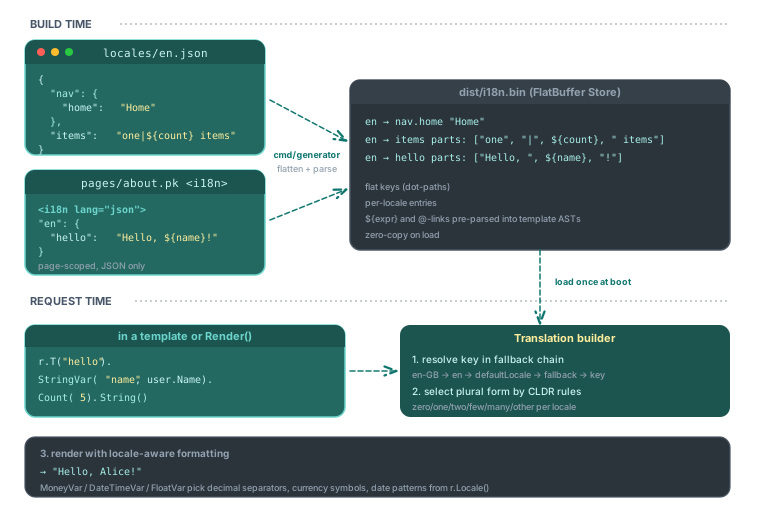
Piko's i18n system is a runtime translation store with a fluent, typed binding API. Translations live as JSON, get flattened into a single FlatBuffer-backed store at build time, and resolve at request time through a builder. The builder takes typed variables and a Common Locale Data Repository (CLDR) aware count. The shape is unusual on two axes at once. The storage is "big runtime store" (familiar from Vue i18n, gettext, and golang.org/x/text), but the binding is fluent typed Go (familiar from the SQL builders, less so for translation libraries). This page explains why Piko picked that combination.
The two problems
Conventional i18n has two shapes that make different trade-offs.
Format-string-with-map is the dominant pattern: T("key", map[string]any{"name": x}). It is concise to write and works fine for prose, but it shifts every error to runtime. A typo in a variable name, a %s where the translation expects a number, a missing key. All surface as broken UI in production. Reviewing diffs is also harder than it should be. An unbound variable in a long template string is invisible until rendering.
Codegen-typed-functions swings the other way. Emit t.Greeting(name string) string per key so the compiler enforces signatures. The cost is that translations now live in two places (the JSON and the regenerated Go). Renaming a key, adding a parameter, or shipping a translation update without a redeploy all become deeper operations than they need to be. The model also struggles with plurals and locale-aware number and date formatting, where the typed signature would have to encode CLDR categories per language.
Piko's choice splits the difference. Keep the translations in a runtime store, so they support hot reload, translator edits, and shipping without code changes. Make the binding API a typed fluent builder that catches the common mistakes the format-string approach surfaces only at render time.
The shape
A call site looks like this:
greeting := r.T("user.greeting").
    StringVar("name", user.Name).
    IntVar("count", inboxCount).
    String()
r.T(key) returns a *Translation value. The fluent setters (StringVar, IntVar, FloatVar, DecimalVar, MoneyVar, BigIntVar, TimeVar, DateTimeVar, Var, Count) each take typed Go arguments and return the same *Translation for chaining. A terminal String() resolves the key against the locale store. It applies the CLDR plural form when the caller set Count(n). It walks the template AST and substitutes the bound variables (with locale-aware formatting for money, dates, and floats), then returns the rendered string.
The builder is the typing layer. The Go compiler catches MoneyVar("price", 19.99) (wants maths.Money, got float64) before it can ever fail at render time. Misspelling a variable name still falls through to a literal, but the bound names are local to the call site, which catches those quickly.
Why FlatBuffers, why a single binary
The build step flattens every translation source (global locales/<locale>.json files plus every page's <i18n> block) and emits a single FlatBuffer. At server boot, the runtime maps that file once. There is no per-request parse, no per-key allocation walk through nested maps, and no template-string parse on the hot path. The build parses templates once into typed parts (literal segments, expression placeholders, linked-message references) and the parts ship in the binary.
The wins are real:
- Cold-start cost is one mmap instead of walking N JSON files and parsing M template strings.
- Translation builders pool through
sync.Pool. A request that callsr.T(...).String()ten times allocates effectively nothing. - Linked references (
@common.brand) resolve through pointer chases inside the loaded buffer, capped at depth 10 to break cycles.
The trade-off is that translations are not editable at runtime in production. A translation update requires regeneration. In development that is not noticeable, since the dev server regenerates on save. A project that needs translator-edits-without-deploy needs to ship JSON in the deploy artefact and reload it.
Why a fluent builder over a format-string-with-map
The two viable shapes for the binding API were:
// Map shape:
r.T("greeting", map[string]any{"name": x, "count": n})

// Fluent shape:
r.T("greeting").StringVar("name", x).IntVar("count", n).String()
The map shape is shorter for the common case. The fluent shape is harder to misuse for the cases that matter:
- Each setter takes a typed value.
MoneyVarrequiresmaths.Money. The compiler rejects the barefloat64that a translator might have intended. The map shape can only enforce types at runtime. Count(n)is a discoverable API surface. With a map the plural-count is just another key. With a builder, the existence ofCounttells the reader plurals exist.- Locale-aware formatting attaches to the value, not the format string.
DateTimeVarselects the formatting style separately from the placeholder, which keeps the translation source readable to non-engineers. - The builder pool model works.
sync.Poolreset semantics are easier to reason about for a builder than for an opaque map.
The cost is verbosity. For a translation that takes one string variable, the fluent form is wordier than the map form. Piko accepts that trade-off.
CLDR plurals
Piko sources its plural rules from the Unicode Common Locale Data Repository (CLDR). A translation declares its plural variants as pipe-separated forms in a single string:
{
  "items": "no items|one item|${count} items"
}
Count(n) selects the right form for the active locale at render time. English uses two forms (singular versus plural). Slavic languages use three (one, two-to-four, five-or-more). Arabic carries six (zero, one, two, three-to-ten, eleven-to-ninety-nine, other). The pipe form is dense, but it keeps the singular and plural variants visually adjacent, which is what translators want when editing.
Piko does not ship the full International Components for Unicode (ICU) MessageFormat. The select-on-arbitrary-key, ordinal, and gender forms add expressivity that pulls the syntax further from anything a translator can edit by hand. CLDR plural rules cover the cases that come up frequently. For the tail of complex grammatical rules, projects can fall through to bare Go and call golang.org/x/text directly.
Two scopes: T versus LT
r.T(key) searches the global store first and the per-page <i18n> block second. r.LT(key) searches only the per-page block. The asymmetry is deliberate.
Most translations belong to global namespaces (nav labels, footer text, error messages, validation copy). T is the right tool for those. A page that uses T("nav.home") benefits from the same global key being available everywhere. Some strings, though, live entirely on one page (the page's own headline, an inline form label that has no global twin). Those go in the page's <i18n> block, and LT exists to make the lookup explicit. Using LT says "I expect this string to be local, surface a fallback if it ever escapes".
The fall-through still works in T's favour. A page that defines <i18n> keys and calls T("local-key") finds them through the local-store fallback. LT is the stricter version for code that wants to know if a global key accidentally shadows a local one.
Routing is separate
The strategy used to encode locale in URLs (/about?lang=fr versus /fr/about versus /en/about) is a router concern, not a translation concern. Piko keeps them apart. A page enables multi-locale routing by declaring SupportedLocales() []string, and the routing layer produces one route per locale under the configured strategy. Pages without SupportedLocales get a single route under the default locale even when other pages opt in.
Four strategies ship. query-only is the default and uses a single bare path with locale from a query parameter or detection. prefix_except_default keeps the default locale bare and prefixes the others. prefix prefixes every locale. disabled makes the router skip locale routing entirely, useful for sites that resolve locale outside the URL. The choice is a single config field. The page-level SupportedLocales opt-in is the same regardless of which strategy is active.
When this design is the wrong fit
Two cases stretch the model:
Translator-driven workflows that need runtime updates. Piko regenerates on deploy, which is fine for most teams. Some translators commit JSON to a separate repository and expect the site to pick it up without a redeploy. That workflow needs a runtime-loadable translations layer, which Piko does not ship by default.
Non-UI text from Go libraries. The <i18n> block and the T/LT API target template and Render-time strings. Error messages from a third-party Go package, CLI output from an admin tool, and similar text live outside this surface. Use golang.org/x/text or a project-local string table for those. They coexist fine, but they are explicitly a separate path.
See also
- i18n API reference for the full
T/LTsurface, all*Varsetters, theDateTimebuilder, and the automatically derived SEO head. - How to add translations to a site for wiring a project from scratch.
- How to choose an i18n routing strategy for the URL options.
- How to pluralise translations for the CLDR (Common Locale Data Repository) pipe form.
- How to bind typed variables to translations for the typed setter surface.
- How to format dates and times for a locale for
DateTimeandTimeVar.