Errors
Piko's error handling separates the message shown to end users from the internal detail recorded in logs. The Error type carries both. Helpers NewError and Errorf construct instances. Development mode shows the internal detail, and production shows only the safe message. This page documents the API. Source file: errors.go.
Type
Error
Type alias for safeerror.Error. Any error in a wrap chain can implement the interface. Piko discovers it via errors.As.
Interface:
| Method | Returns |
|---|---|
Error() string | Full internal string (logged server-side). Inherited from the standard error interface. |
SafeMessage() string | User-visible message. |
Concrete instances returned by NewError and Errorf also implement Unwrap() error, so errors.Is and errors.As traverse the wrapped cause. The interface itself does not require Unwrap. Any error type that adds a SafeMessage() string method satisfies it.
Functions
NewError(safeMessage string, cause error) error
Wraps a cause error with a user-safe message.
func Render(r *piko.RequestData, props piko.NoProps) (Response, piko.Metadata, error) {
    user, err := loadUser(r.Context(), id)
    if err != nil {
        return Response{}, piko.Metadata{}, piko.NewError("could not load user profile", err)
    }
    return Response{User: user}, piko.Metadata{}, nil
}
In production, the end user sees "could not load user profile". The log line contains the full underlying cause.
Errorf(safeMessage string, internalFormat string, args ...any) error
Same contract as NewError but with a fmt.Errorf-style internal format:
return piko.Errorf("could not process order",
    "loading order %s from database: %w", orderID, err)
The %w verb still produces a wrapped error compatible with errors.Is and errors.As.
IsDevelopmentMode(r *RequestData) bool
Reports whether Piko is serving the current request in development mode (piko dev or piko dev-i). Returns false when r is nil or the context lacks development-mode information.
Use inside error-page Render functions to decide whether to expose internal detail:
func Render(r *piko.RequestData, props piko.NoProps) (Response, piko.Metadata, error) {
    errCtx := piko.GetErrorContext(r)
    if errCtx == nil {
        return Response{Message: "Unknown error"}, piko.Metadata{}, nil
    }

    message := errCtx.Message
    if piko.IsDevelopmentMode(r) && errCtx.InternalMessage != "" {
        message = errCtx.InternalMessage
    }

    return Response{Code: errCtx.StatusCode, Message: message}, piko.Metadata{}, nil
}
Typed errors for validation
| Helper | Use | HTTP status |
|---|---|---|
piko.ValidationField(field, message) | Attach a validation message to a specific form field. | 422 |
piko.NewValidationError(fields map[string]string) | Multi-field validation error. | 422 |
These integrate with action forms. The dispatch layer maps each field error to the matching input.
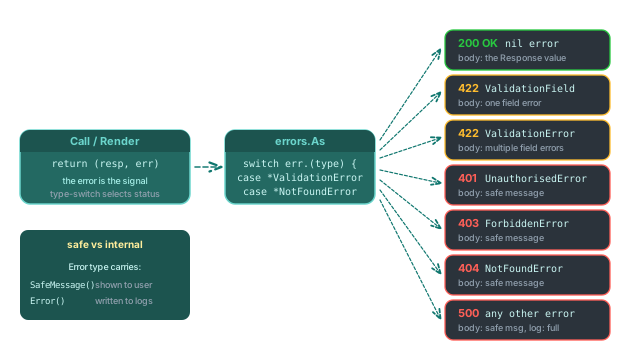
HTTP status mapping
Action Call and page Render return an error that Piko maps to an HTTP status:
| Error shape | HTTP status |
|---|---|
nil | 200 |
piko.ValidationField, piko.NewValidationError | 422 |
piko.BadRequestError | 400 |
piko.UnauthorisedError | 401 |
piko.ForbiddenError | 403 |
piko.NotFoundError | 404 |
piko.ConflictError | 409 |
piko.TeapotError | 418 |
piko.GenericPageError | 500 |
Any other error | 500 (logged with full detail; user sees a generic message) |
Error-page context
GetErrorContext(r) returns the error details available to a custom error page:
type ErrorPageContext struct {
    Message         string
    InternalMessage string
    OriginalPath    string
    StatusCode      int
}
| Field | Purpose |
|---|---|
Message | Human-readable error message safe for display to users. |
InternalMessage | Full internal error detail, populated only in development mode (piko dev or piko dev-i). Empty in production. |
OriginalPath | Request path that triggered the error. |
StatusCode | HTTP status code for the error (for example, 404 or 500). |
See also
- How to error pages.
- Server actions reference for validation errors.
- Routing rules reference for setting status codes.
- Source:
errors.go.