Lifecycle API
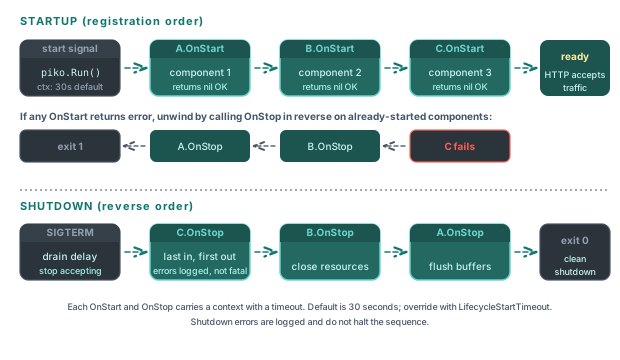
Components that need managed startup or graceful shutdown implement one or more of the lifecycle interfaces. Piko starts registered components in declaration order before accepting HTTP traffic, and stops them in reverse order during shutdown. This page documents the interfaces. For task recipes see the lifecycle how-to. Source file: lifecycle.go.
Registering a component
func (s *SSRServer) RegisterLifecycle(component LifecycleComponent)
Defined at piko.go:257. Call before Run:
ssr := piko.New()
ssr.RegisterLifecycle(myDatabaseComponent)
ssr.RegisterLifecycle(myCacheComponent)
ssr.Run(actions, piko.RunModeDev)
Components start in registration order and stop in reverse. See Function-style shutdown hooks for teardown without a full component.
Interfaces
LifecycleComponent
The base interface. Every lifecycle-managed component implements it.
type LifecycleComponent interface {
    OnStart(ctx context.Context) error
    OnStop(ctx context.Context) error
    Name() string
}
| Method | Behaviour |
|---|---|
OnStart(ctx) | Runs during startup before the server accepts traffic. Returning an error stops the server from starting. The context carries a timeout (default 30 seconds). |
OnStop(ctx) | Runs during graceful shutdown. The context carries a timeout. Piko logs any returned error but does not halt shutdown. |
Name() | Returns a human-readable name used for logs and health-endpoint output. |
Components start in registration order and stop in reverse order. A component may depend on any component registered before it.
LifecycleStartTimeout
Optional interface. Overrides the default 30-second startup timeout for the implementing component.
type LifecycleStartTimeout interface {
    StartTimeout() time.Duration
}
LifecycleHealthProbe
Optional interface. Components implementing it register as health probes for the /live and /ready endpoints.
type LifecycleHealthProbe interface {
    healthprobe_domain.Probe
}
Probe requires a Check(ctx, checkType) method that returns a HealthStatus. See the health API reference.
LifecycleWithHealth
Combination of LifecycleComponent and LifecycleHealthProbe.
type LifecycleWithHealth interface {
    LifecycleComponent
    LifecycleHealthProbe
}
Default health behaviour
A component that implements LifecycleComponent but not LifecycleHealthProbe still produces a probe. The default probe reports:
| Check | State |
|---|---|
| Liveness | Healthy with message "Component is running (no custom health check provided)". |
| Readiness | Degraded with message "Component does not provide readiness check". |
Implement LifecycleHealthProbe to override.
Startup failure handling
If any OnStart returns an error:
- Piko logs the error with the component name.
- Piko calls
OnStopon every component that has already started, in reverse order. - The server exits without accepting traffic.
Shutdown sequence
On SIGTERM or SIGINT:
- The server stops accepting new connections.
- The configured shutdown drain delay elapses (see
WithShutdownDrainDelay). - Every registered
LifecycleComponent'sOnStopruns in reverse order. - The process exits.
Function-style shutdown hooks
wdk/lifecycle.Register adds a teardown function without requiring a full LifecycleComponent.
import "piko.sh/piko/wdk/lifecycle"

lifecycle.Register(ctx, "flush-buffer", func(ctx context.Context) error {
    return buffer.Flush(ctx)
})
Signature: Register(ctx context.Context, name string, cleanupFunction func(context.Context) error). Hooks run during graceful shutdown alongside LifecycleComponent.OnStop. The name argument labels the hook in shutdown logs.