How to use the event bus for cross-component messaging
Components that do not share a parent-child relationship cannot communicate via props or custom DOM events. The global piko.bus provides a publish/subscribe channel that any component can use. See the client components reference for the broader API.
When to prefer the bus, when to prefer attribute writes
The bus is for messages that do not map to a state field. If you want to push a value to another component (a search query, a selection, a flag), set the attribute on it instead. The receiving PKC's reactive state updates automatically (see how to share state between components). Reach for the bus when:
- The message is a one-shot signal (
'app:reload-needed','cart:flush'). - A single emit needs to fan out to unrelated subscribers.
- The publisher has no JavaScript reference to the subscriber's element and no way to look it up.
- The payload has no natural attribute representation (a complex object, a
Map, a stream of partial events).
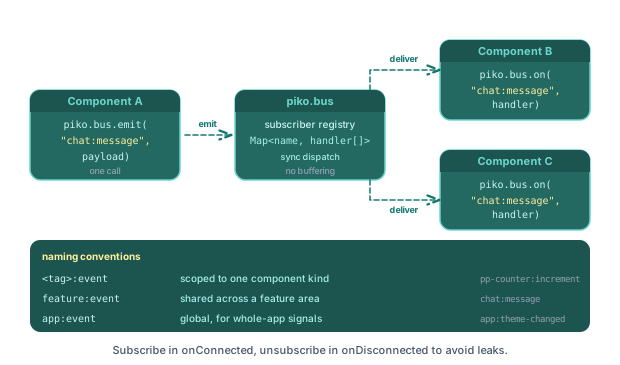
Emit an event
Any component can publish on the bus:
function notifyUsers() {
    piko.bus.emit('chat:message', {
        user: state.currentUser,
        text: state.draft,
        at: new Date().toISOString(),
    });
}
The first argument is the event name. Use a prefix to avoid collisions. The second argument is the payload.
Subscribe to an event
piko.bus.on(name, handler) returns a () => void unsubscribe function. Capture it in onConnected and call it in onDisconnected:
let offMessage: (() => void) | undefined;

pkc.onConnected(() => {
    offMessage = piko.bus.on('chat:message', handleMessage);
});

pkc.onDisconnected(() => {
    offMessage?.();
});

function handleMessage(payload: { user: string; text: string; at: string }) {
    state.messages.push(payload);
}
Always pair subscription and unsubscription via the returned function. piko.bus.off(name) removes every listener for name, not the specific handler, so the function-return form is the only way to detach a single subscriber safely.
Subscribe once
Register a handler that fires exactly once:
piko.bus.once('app:ready', () => {
    console.log('ready');
});
Naming convention
Use a namespace prefix to keep event names readable and non-overlapping:
| Prefix | Use |
|---|---|
<component-tag>: | Events from a specific component: pp-counter:changed |
app: | Application-wide events: app:ready, app:locale-change |
chat:, auth:, etc. | Feature-area events |
See also
- How to share state between components for the attribute-write alternative when a message maps to a state field.
- How to events for intra-component event handling.
- Client components reference.
- About reactivity for the PK/PKC island model the event bus crosses.