How to apply middleware to a page
Pages attach standard func(http.Handler) http.Handler middleware to their route by exporting a Middlewares function from the Go script block. Piko wraps the page handler in the returned slice. For the routing primitives see routing rules reference.
Define Middlewares on the page
<template>
  <piko:partial is="layout" :server.page_title="'Admin dashboard'">
    <h1>Admin dashboard</h1>
    <p>Welcome, {{ state.User.Name }}</p>
  </piko:partial>
</template>

<script type="application/x-go">
package main

import (
    "net/http"

    "piko.sh/piko"
    "myapp/pkg/auth"
    layout "myapp/partials/layout.pk"
)

type Response struct {
    User auth.User
}

func Render(r *piko.RequestData, props piko.NoProps) (Response, piko.Metadata, error) {
    user := auth.UserFromContext(r.Context())
    return Response{User: user}, piko.Metadata{Title: "Admin Dashboard"}, nil
}

// Middlewares returns HTTP middleware applied to this route.
// Order in the slice is application order; the first entry wraps the rest.
func Middlewares() []func(http.Handler) http.Handler {
    return []func(http.Handler) http.Handler{
        auth.RequireAuthenticated,
        auth.RequireAdmin,
    }
}
</script>
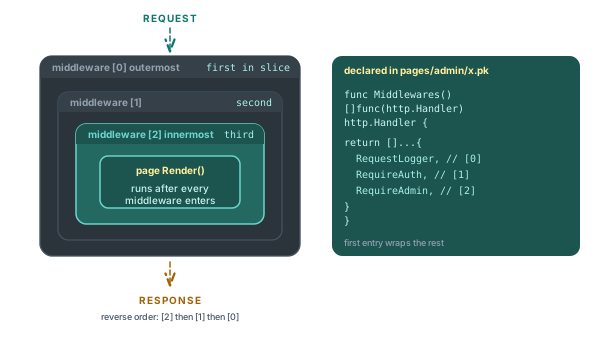
Understand the execution order
Note: Piko wraps from the last slice entry inward, so index
[0]is the outermost layer and the last entry is closest toRender. Treat the first entry as the layer that sees requests first and responses last (auth, logging belong here); treat the last entry as the layer closest to the page logic.
Piko wraps the handler from the last entry to the first, so the first entry in the slice runs first on the request and last on the response:
func Middlewares() []func(http.Handler) http.Handler {
    return []func(http.Handler) http.Handler{
        firstMiddleware,   // outermost: first to see the request, last to see the response
        secondMiddleware,
        thirdMiddleware,   // innermost: last to see the request, first to see the response
    }
}
This matches the standard Go HTTP middleware idiom (m1(m2(m3(handler)))).
Common middleware patterns
Authentication gate:
func RequireAuthenticated(next http.Handler) http.Handler {
    return http.HandlerFunc(func(w http.ResponseWriter, r *http.Request) {
        user, err := auth.GetUserFromSession(r)
        if err != nil {
            http.Redirect(w, r, "/login", http.StatusFound)
            return
        }
        ctx := auth.WithUser(r.Context(), user)
        next.ServeHTTP(w, r.WithContext(ctx))
    })
}
Request logging:
func RequestLogger(next http.Handler) http.Handler {
    return http.HandlerFunc(func(w http.ResponseWriter, r *http.Request) {
        start := time.Now()
        next.ServeHTTP(w, r)
        log.Info("Request completed",
            logger.String("path", r.URL.Path),
            logger.Duration("duration", time.Since(start)),
        )
    })
}
See also
- Routing rules reference for path matching and priority.
- About routing for where middleware sits in the request lifecycle.
- How to set a cache policy on a page for the matching cache hook.
- How to security for the wider authentication and CSRF picture.