Testing what you built
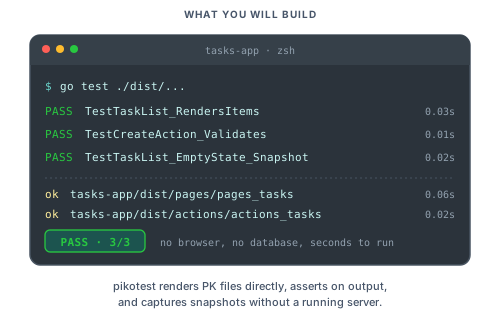
In this tutorial we add a test suite to the task manager from Data-backed pages with the querier. The suite covers a component test for the task list, an action test for the Create action, and a snapshot over the empty state.
Step 1: Add a database test helper
Create testhelpers/db.go:
package testhelpers

import (
    "context"
    "database/sql"
    "testing"

    _ "modernc.org/sqlite"

    "myapp/db/generated"
)

// OpenMemoryDB returns a fresh in-memory SQLite connection seeded with the
// task schema. Each call gives a clean database.
func OpenMemoryDB(t *testing.T) *sql.DB {
    t.Helper()

    db, err := sql.Open("sqlite", ":memory:")
    if err != nil {
        t.Fatalf("open: %v", err)
    }
    t.Cleanup(func() { db.Close() })

    _, err = db.Exec(`
        CREATE TABLE tasks (
          id INTEGER PRIMARY KEY AUTOINCREMENT,
          title TEXT NOT NULL,
          completed INTEGER NOT NULL DEFAULT 0,
          created_at INTEGER NOT NULL
        );
    `)
    if err != nil {
        t.Fatalf("schema: %v", err)
    }

    return db
}

// SeedTasks inserts a small fixture for tests that need existing data.
func SeedTasks(t *testing.T, db *sql.DB, titles ...string) {
    t.Helper()
    q := generated.New(db)
    for i, title := range titles {
        if _, err := q.CreateTask(context.Background(), generated.CreateTaskParams{
            P1: title,
            P2: int32(1_700_000_000 + i),
        }); err != nil {
            t.Fatalf("seed: %v", err)
        }
    }
}
Step 2: Make the app read the database from context
Tests need to inject their own connection. Create dbconn/conn.go:
package dbconn

import (
    "context"
    "database/sql"

    "piko.sh/piko/wdk/db"
)

type ctxKey struct{}

func WithConn(ctx context.Context, c *sql.DB) context.Context {
    return context.WithValue(ctx, ctxKey{}, c)
}

func Conn(ctx context.Context) (*sql.DB, error) {
    if c, ok := ctx.Value(ctxKey{}).(*sql.DB); ok {
        return c, nil
    }
    return db.GetDatabaseConnection("tasks")
}
Update the task-list partial to use the new helper. In partials/task-list.pk, swap the connection lookup:
conn, err := dbconn.Conn(r.Context())
Apply the same change to actions/tasks/create.go, replacing db.GetDatabaseConnection("tasks") with dbconn.Conn(a.Ctx()). The toggle and delete actions follow the same pattern.
Production behaviour is identical because Conn falls through to the bootstrap registry when no test connection is present.
Step 3: Write the first component test
Create src/partials/task_list_pikotest_test.go next to the partial. The generator emits a per-partial Go package under dist/partials/. List it to find the exact import path:
ls dist/partials | grep task_list
# partials_task_list_a1b2c3d4
Use the printed directory name (here partials_task_list_a1b2c3d4) as the last segment of the import:
package partials_test

import (
    "context"
    "testing"

    "piko.sh/piko"

    taskList "myapp/dist/partials/partials_task_list_a1b2c3d4"
    "myapp/dbconn"
    "myapp/testhelpers"
)

func TestTaskListPartial_EmptyState(t *testing.T) {
    db := testhelpers.OpenMemoryDB(t)
    ctx := dbconn.WithConn(context.Background(), db)

    req := piko.NewTestRequest("GET", "/").Build(ctx)

    tester := piko.NewComponentTester(t, taskList.BuildAST)
    view := tester.Render(req, piko.NoProps{})

    view.QueryAST("ul.task-list").NotExists()
    view.QueryAST("p.empty-message").Exists()
    view.QueryAST("p.empty-message").ContainsText("No tasks yet")
}
Run the test:
go test ./src/partials/...
A single pass.
Step 4: Cover the populated state
Add a second test to the same file:
func TestTaskListPartial_PopulatedState(t *testing.T) {
    db := testhelpers.OpenMemoryDB(t)
    testhelpers.SeedTasks(t, db, "buy milk", "walk the dog", "write tests")

    ctx := dbconn.WithConn(context.Background(), db)
    req := piko.NewTestRequest("GET", "/").Build(ctx)

    tester := piko.NewComponentTester(t, taskList.BuildAST)
    view := tester.Render(req, piko.NoProps{})

    view.QueryAST("li.task-item").Count(3)
    view.QueryAST("li.task-item").FirstResult().ContainsText("write tests")
    view.QueryAST("p.empty-message").NotExists()
}
Re-run go test ./src/partials/.... Both tests pass. SeedTasks uses increasing timestamps so the partial's ORDER BY created_at DESC puts "write tests" first.
Step 5: Tighten the Create action
Add an explicit title guard at the top of Call so the action validates its own input. See about the action protocol for why validate:"..." tags do not fire under pikotest.
Update actions/tasks/create.go:
func (a CreateAction) Call(input CreateInput) (CreateResponse, error) {
    if strings.TrimSpace(input.Title) == "" {
        return CreateResponse{}, piko.ValidationField("title", "Title is required.")
    }

    conn, err := dbconn.Conn(a.Ctx())
    if err != nil {
        return CreateResponse{}, err
    }

    queries := generated.New(conn)
    row, err := queries.CreateTask(a.Ctx(), generated.CreateTaskParams{
        P1: input.Title,
        P2: int32(time.Now().Unix()),
    })
    if err != nil {
        return CreateResponse{}, err
    }

    return CreateResponse{ID: row.ID, Title: row.Title}, nil
}
Add "strings" to the import block. The action tester surfaces the resulting error through result.AssertError() and result.AssertErrorContains(...). See errors reference for ValidationField and the 422 mapping.
Step 6: Write an action test
Add a registry helper at testhelpers/actions.go:
package testhelpers

import (
    "piko.sh/piko"

    actions "myapp/dist/actions"
)

func ActionEntry(name string) piko.ActionHandlerEntry {
    handler, ok := actions.Registry()[name]
    if !ok {
        panic("unknown action: " + name)
    }
    return piko.ActionHandlerEntry{
        Name:   handler.Name,
        Method: handler.Method,
        Create: handler.Create,
        Invoke: handler.Invoke,
        HasSSE: handler.HasSSE,
    }
}
Then create actions/tasks/create_test.go:
package tasks_test

import (
    "context"
    "testing"

    "piko.sh/piko"

    "myapp/actions/tasks"
    "myapp/dbconn"
    "myapp/testhelpers"
)

func TestCreateAction_Success(t *testing.T) {
    db := testhelpers.OpenMemoryDB(t)
    ctx := dbconn.WithConn(context.Background(), db)

    tester := piko.NewActionTester(t, testhelpers.ActionEntry("tasks.Create"))
    result := tester.Invoke(ctx, map[string]any{
        "title": "buy milk",
    })

    result.AssertSuccess()
    data, ok := result.Data().(tasks.CreateResponse)
    if !ok {
        t.Fatalf("expected tasks.CreateResponse, got %T", result.Data())
    }
    if data.Title != "buy milk" {
        t.Fatalf("got title %q, want buy milk", data.Title)
    }
    if data.ID == 0 {
        t.Fatal("expected a non-zero ID")
    }
}

func TestCreateAction_ValidationError(t *testing.T) {
    db := testhelpers.OpenMemoryDB(t)
    ctx := dbconn.WithConn(context.Background(), db)

    tester := piko.NewActionTester(t, testhelpers.ActionEntry("tasks.Create"))
    result := tester.Invoke(ctx, map[string]any{
        "title": "",
    })

    result.AssertError()
    result.AssertErrorContains("title")
}
Run go test ./actions/tasks/.... Both tests pass. The empty title trips the manual guard added in step 5 and the action returns a ValidationError before touching the database.
For the full *ActionResultView assertion surface see testing API reference.
Step 7: Pin the empty-state markup
Snapshot tests in pikotest require a wired RenderService, which is only constructed by the framework's bootstrap pipeline. The default piko.NewComponentTester runs without one so most assertions stay fast and dependency-free. For tutorial-grade markup pinning, AST queries cover the same ground without a renderer. Add to the partial test:
func TestTaskListPartial_EmptyStateMarkup(t *testing.T) {
    db := testhelpers.OpenMemoryDB(t)
    ctx := dbconn.WithConn(context.Background(), db)

    req := piko.NewTestRequest("GET", "/").Build(ctx)
    tester := piko.NewComponentTester(t, taskList.BuildAST)
    view := tester.Render(req, piko.NoProps{})

    view.QueryAST("ul.task-list").NotExists()
    view.QueryAST("p.empty-message").Exists()
    view.QueryAST("p.empty-message").HasText("No tasks yet. Add one above.")
    view.QueryAST("div.task-list-container").Exists()
}
Each assertion targets one structural promise. If a future change drops the empty-message paragraph, replaces the wrapper class, or surfaces the list early, the relevant line fails with a clear diagnostic. Diffs in a pull request make visual changes reviewable without a golden file to maintain.
Note: True HTML snapshots (
view.MatchSnapshot(...)) require attaching aRenderServicevia the internalpikotest_domain.WithRendereroption, which is not part of the public API surface. AST queries are the supported surface for partial-level structural tests.
Step 8: Run everything
go test ./...
The full suite passes in well under a second.
Where to next
- Next tutorial: Going multilingual adds i18n to the blog from tutorial 04.
- Reference: Testing API reference for the full builder, tester, and assertion surface; browser testing reference.
- Explanation: About browser testing covers the runtime model used by the headless harness.
- How-to: Testing for mocking, benchmarking, and table-driven patterns; browser testing for client-side and middleware coverage.
- Runnable source:
examples/scenarios/022_database_sqlite/is the canonical task-manager scenario this tutorial extends.